



Geneva, Switzerland – September 16, 2026
The Office of Justin Sun announced the establishment of The Justin Sun Prize, described as a decentralised, “zero-trust” academic bounty system built around a publicly maintained list of mathematical problems.
A new international academic prize designed to reward breakthroughs in mathematics, formal verification and AI-assisted scientific discovery, with a top award of US$1 million for solving a single problem.

Unlike conventional academic prizes, the initiative does not rely on nominations, institutional affiliation or professional credentials. Instead, awards are tied directly to specific mathematical problems and the production of proofs capable of formal machine verification.
The initiative is intended to explore a new model for scientific recognition at a time when artificial intelligence is becoming increasingly involved in advanced mathematical and scientific research.
“Nobel Prize of the AI Era
OpenAI research team among the first group of prize recipients
The Office of Justin Sun also announced what it described as the first group of prize recipients, covering solutions and formalised proofs relating to 66 mathematical problems.
According to the announcement, the top US$1 million award has been allocated to an OpenAI research team in recognition of a reported solution and formalised proof relating to the Existence and Smoothness of the Three-Dimensional Navier–Stokes Equations.
The Office of Justin Sun states that the proof was produced using an OpenAI internal model, with formalisation and verification in the Lean theorem-proving environment subsequently completed using an AI system.
The Navier–Stokes equations are among the fundamental mathematical equations used to describe the motion of fluids.
Developed through the work of the French engineer and physicist Claude-Louis Navier, the Irish-born mathematician and physicist George Gabriel Stokes, and others during the 19th century, they remain central to areas ranging from aerodynamics and weather modelling to oceanography and engineering.
In 2000, the Clay Mathematics Institute selected the Navier–Stokes existence and smoothness problem as one of its seven celebrated Millennium Prize Problems, each carrying a US$1 million prize for a qualifying solution.
“An award named after a person is the least political thing in the world,” Sun said. “More importantly, it gives me an answer to myself—my wealth is rooted in mathematics. It came from mathematics, and it will return to mathematics.”
Justin Sun
A different model for scientific rewards
The Justin Sun Prize is designed to operate differently from traditional academic awards.
There are no conventional nomination procedures or credential requirements, and prizes are not tied to periodic award ceremonies or lifetime achievement.
Instead, each award is connected to a clearly identified problem. The first person or team to produce a qualifying breakthrough and satisfy the specified verification requirements can receive the corresponding prize.
Sun’s stated ambition is for the initiative eventually to become what his office describes as the “Nobel Prize of the AI Era”—a system in which scientific achievement can be assessed through transparent, formally verifiable evidence.
The underlying repository of mathematical problems and formalised computer code is intended to remain publicly accessible and continuously updated.
Once a problem has been placed on the prize list, the organisers say it cannot subsequently be removed, although new problems may be added. Awards already paid will not be reclaimed.
From the Riemann Hypothesis to Goldbach’s Conjecture
The current list encompasses some of the best-known questions in mathematics.
Among the subjects identified by the organisers are formal verification associated with the Poincaré Conjecture, the Riemann Hypothesis and Goldbach’s Conjecture, together with numerous unresolved problems associated with the late Hungarian mathematician and Wolf Prize laureate Paul Erdős.
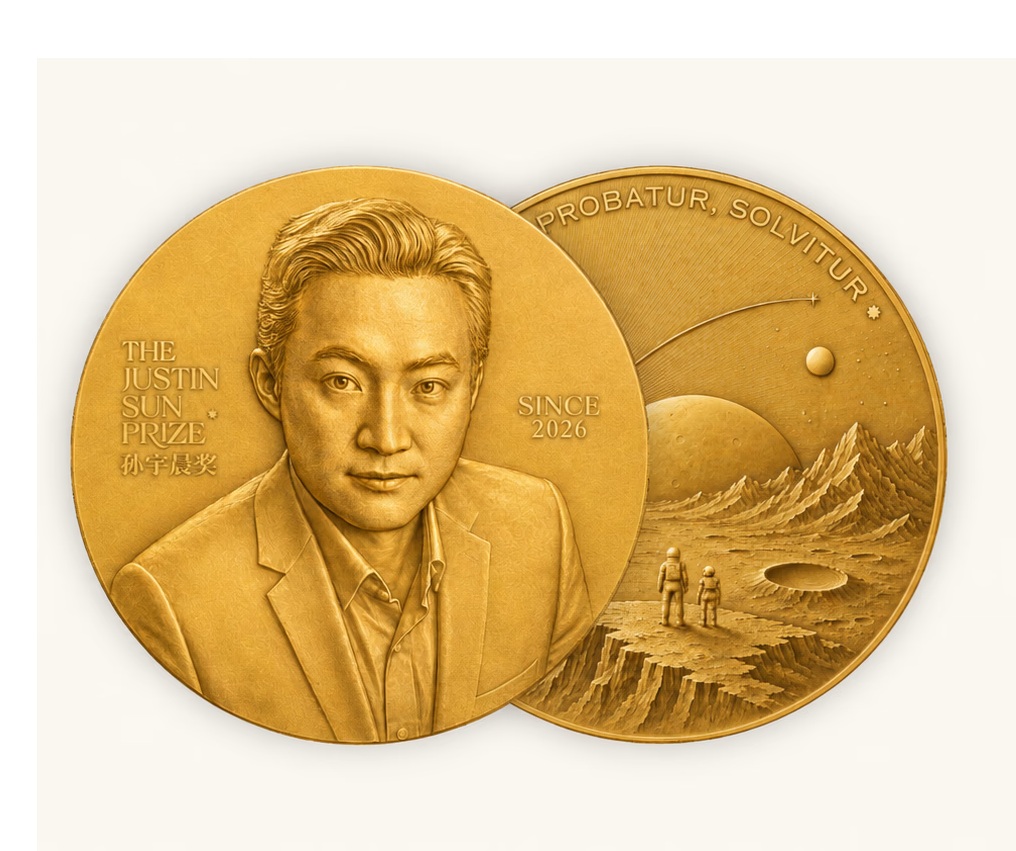
Prize recipients will receive a monetary award together with a certificate and medal.
Inscribed around the medal is the Latin phrase: “Quod probatur, solvitur” – “Proved, then paid.”
The phrase encapsulates the central philosophy behind the project: that mathematical achievement should ultimately be determined by the validity and verifiability of the proof.
Humans and AI judged by the same standard
The prize is based around three stated principles: openness, public benefit and open source.
According to its organisers, participation is open irrespective of nationality, institution or identity. The scheme is also unusual in making no formal distinction between work completed by humans and work produced with artificial intelligence.
The initiative says its funds will be used for prizes and open scientific programmes rather than commercial profit.
Problem lists, verification standards, proofs and associated materials are intended to be published openly, including through GitHub, while prize payments will be recorded on blockchain networks to provide a permanent transaction record.
Sun said the decision to attach his own name to the initiative reflected his relationship with mathematics and technology.
The Office of Justin Sun says Sun has donated more than US$45 million across technology, environmental protection, disaster relief and other charitable initiatives.
It says the Justin Sun Prize will now become one of the central elements of his philanthropic activity, with a particular emphasis on fundamental scientific research.
Cryptocurrency-based prize payments
Prize recipients will be able to elect to receive payments in either USDT on the TRON blockchain using the TRC-20 standard or USDC on Ethereum using ERC-20, according to the organisers.
Further information about the programme and its mathematical problem list is available through the official Justin Sun Prize website at www.hejustinsun.com/prize.
About the Justin Sun Prize
The Justin Sun Prize is an academic initiative established to encourage advances in mathematics, formal verification and AI-assisted scientific discovery.
Its underlying principle is that mathematical work should be judged primarily by the rigour, validity and verifiability of the proof itself, rather than by the reputation, institution or professional status of the person submitting it.
The programme connects defined mathematical challenges with machine-verifiable proofs and is structured around openness, public benefit and open-source access.
About Justin Sun
Justin Sun is the founder of TRON, the blockchain network closely associated with the global use of the USDT stablecoin.
He has also served as Grenada’s Ambassador and Permanent Representative to the World Trade Organization.
Sun has been a prominent figure in the international digital-asset sector and has appeared several times in Forbes‘ 30 Under 30 coverage. He was also the subject of a Forbes cover profile in 2025.
In August 2025, Sun travelled aboard Blue Origin’s NS-34 mission, extending his interests beyond blockchain and investment into space exploration.
His activities span technology, digital assets, investment, philanthropy, art, gaming, and scientific research.
Office of Justin Sun Contact:
Visit https://www.hejustinsun.com/prize for more information.
https://en.wikipedia.org/wiki/Justin_Sun
Contact: